






California’s mix of coastal, valley, desert, and mountain climates calls for insulation that blocks summer heat, holds winter comfort, and manages air and moisture without trapping it. The approach pairs targeted air sealing with the right R‑values and materials for attics, roofs, walls, and floors—documented to meet Title 24 and verification requirements.
Overview
- Scope: energy/comfort assessment, air sealing, attic and roof insulation, wall and floor/crawlspace insulation, duct sealing/wrap, radiant barrier and cool-roof interfaces, and documentation for Title 24 and HERS/QII.
- Goals: lower loads, stable indoor temps, quieter rooms, controlled moisture, and verifiable performance.
- Settings: occupied retrofits, additions, new builds, and targeted upgrades (attic-first strategies).
What This Service Includes
- Assessment: visual inspection, leakage mapping, and recommendations tuned to California climate zones (coastal marine, inland hot‑dry, desert, and mountain).
- Air sealing: foaming and gasketing at top plates, can lights (ICAT), chases, plumbing/electrical penetrations, attic hatches, and rim/band joists.
- Attic upgrades: blown cellulose or fiberglass to depth markers (often R‑38 to R‑49), baffles at eaves, insulated/latched hatch covers, and damming around fixtures.
- Roof & radiant control: radiant barriers or above‑deck venting where heat gain is high; alignment with cool-roof membranes per Title 24 options.
- Walls: dense‑pack cellulose or fiberglass for closed cavities, batt/mineral wool for open walls, and exterior continuous insulation where cladding allows.
- Floors & crawlspaces: batt or rigid insulation at floors over garages/crawlspaces; vapor-smart approaches near the coast; ground covers and perimeter details to limit moisture and pests.
- Ducts: sealing with mastic/tape, R‑8 wrap in attics, and relocation/encapsulation strategies to reduce attic heat penalty.
- Verification: preparation for HERS/QII inspections, photos, and insulation grade documentation as specified.
California Climate & Code Notes
- Title 24: prescriptive targets commonly include high attic R‑values, duct sealing and insulation, and verified quality installation (QII) credits on some projects.
- Hot‑dry valleys/deserts: radiant barriers, cool roof pairings, shaded/vented attics, and attention to duct location to cut summer peaks.
- Coastal/marine: vapor-open wall assemblies (no interior poly), robust air sealing, and corrosion-aware fasteners; focus on wind‑driven moisture at eaves.
- Mountain zones: higher R‑values at roof and walls, balanced ventilation, and ice‑dam control (air sealing first, then insulation).
- Wildfire interface (WUI): mineral wool and exterior rigid insulation protected by ignition‑resistant claddings; ember‑resistant eave vents complement insulation performance.
Materials & Assemblies
- Blown cellulose/fiberglass: cost‑effective for attics; fills irregular spaces; easy to top up.
- Batts/mineral wool: predictable thickness in open cavities; mineral wool adds fire and sound benefits.
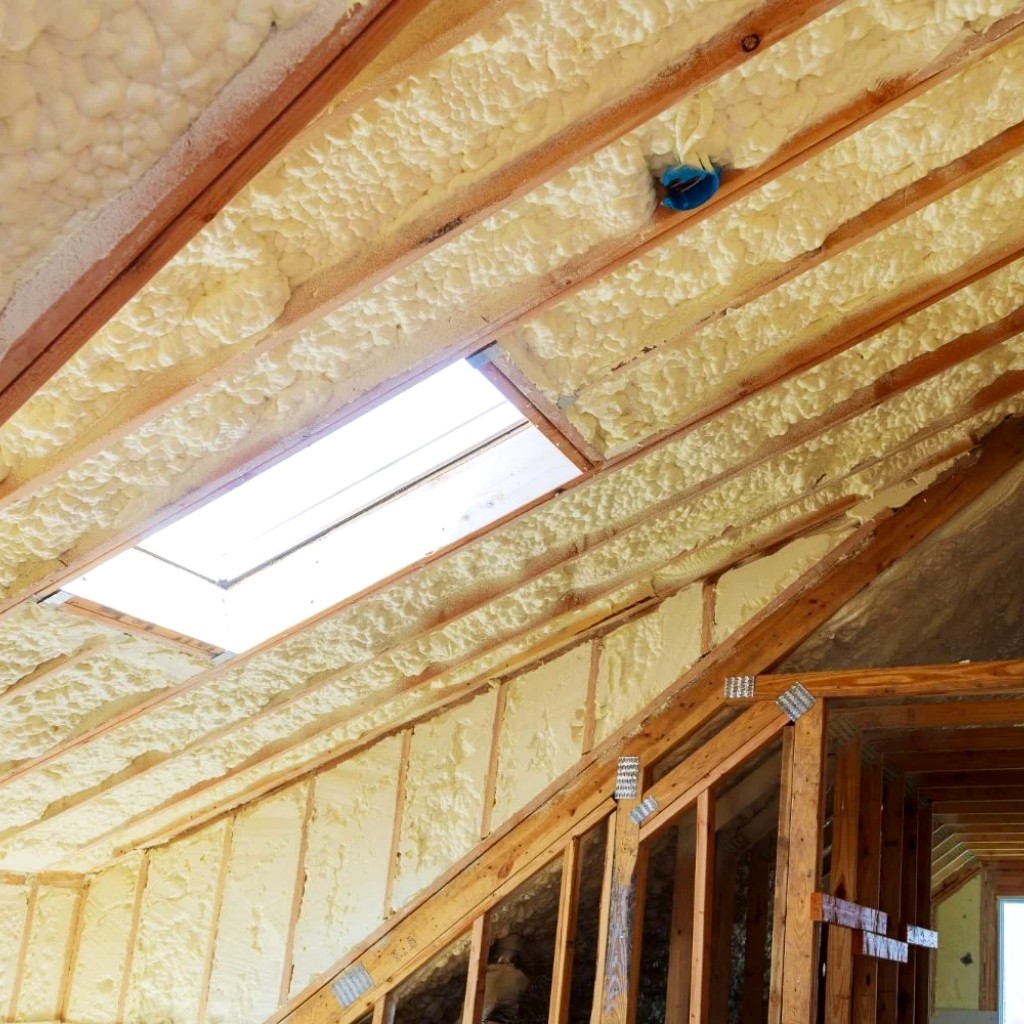
- Spray foam: selective use for air sealing/complex cavities; closed‑cell for vapor control in specific assemblies.
- Exterior rigid: EPS/XPS or mineral wool boards for continuous insulation; breaks thermal bridges and supports higher overall R‑values.
Attics & Roofs
- Target R‑38 to R‑49 in many zones; depth markers and rulers confirm coverage.
- Eave baffles maintain ventilation; top‑plate and chase air sealing comes first.
- Cathedral ceilings: vented channels or unvented assemblies with appropriate foam ratios to manage condensation.
- Attic hatches and pull‑downs insulated and gasketed; platform dams keep insulation in place.
Walls, Floors & Crawls
- Dense‑pack for closed walls; batts fitted full‑depth without compression in open studs.
- Exterior foam or mineral wool for thermal bridging reduction during re‑siding.
- Floors over garages/crawlspaces insulated with sealed rim‑joists; ground covers and perimeter details limit moisture and pests.
Air Sealing, Ventilation & Ducts
- Gaskets/foam at penetrations, top/bottom plates, and attic access; can lights upgraded to ICAT or boxed.
- Balanced ventilation considered when leakage is reduced; bath and range exhausts terminate outdoors.
- Duct leakage addressed with mastic; R‑8 wrap in attics; relocation or encapsulation reduces thermal penalty.
Testing & Verification
- Quality Insulation Installation (QII) prep and checklists to improve compliance margin.
- HERS verifications where required: duct leakage, airflow, and insulation quality.
- Infrared spot checks and depth measurements confirm coverage and identify gaps.
Sequencing & Coordination
- Air sealing before insulation; electrical and low‑voltage roughs confirmed to minimize future disturbance.
- Roofing and attic work coordinated for radiant barrier or roof‑deck changes.
- Drywall timing aligned for wall dense‑pack or batt placement; siding schedules matched for exterior foam.
Quality Markers
- Even insulation depth with no voids, gaps, or compression; rulers visible at multiple points.
- Continuous air seal at penetrations and top plates; attic access insulated and gasketed.
- Ducts sealed and insulated; radiant barrier or cool‑roof interface installed cleanly where specified.
Safety, Compliance & Rebates
- Title 24 and local amendments followed; combustion safety checked when tightening older homes with gas appliances.
- PPE and silica‑aware practices during cutting/foaming; fire ratings respected around fixtures and flues.
- Utility or program rebates may apply; documentation provided as requested for verification.
Care & Maintenance
- Periodically check attic hatches, eave vents, and duct insulation for disturbance.
- Keep bath/range exhausts functional; replace filters and maintain ventilation to control humidity.
- Top up attic insulation after electrical or low‑voltage changes if levels are disturbed.